Key Takeaways
Woven wood shades bring natural texture to a room, but their real value comes from choosing the right weave, lining, and operating style for each window.
- Bamboo, jute, grasses, reeds, and other natural fibers create warmth and visual depth.
- Open weaves filter daylight, while tighter weaves and liners improve privacy and darkness.
- Natural woven materials provide some insulation, though they are not a substitute for proper home insulation.
- Cordless and motorized controls can make shades safer and easier to use.
- Careful measuring and professional installation help the finished treatment look intentional and work properly.
What woven wood shades are and how they work
Woven wood shades are window coverings made by weaving natural fibers into a flexible panel. They soften incoming daylight and add dimension that flat synthetic materials often lack. The practical question is not whether they look beautiful; it is how their material, weave, and lining will behave in your room.
Natural materials used in woven shades
Bamboo, jute, grasses, and reeds are common materials in woven shades. Bamboo is strong and fast-growing, while jute and grasses bring a softer, more irregular texture. Some designs also include fine wood elements or paper fibers, creating subtle variation from one shade to the next.
That variation is part of the appeal. Natural materials are not perfectly uniform, so a shade may have small changes in tone and texture. If you want a window treatment that feels warm rather than manufactured, that character can be a real advantage.
How different weave densities affect performance
Weave density describes how closely the fibers sit together. An open weave allows more daylight through and preserves a lighter, airier feeling. A tighter weave dims the room more and gives you a stronger starting point for privacy, although it may still need a liner for evening coverage.
Think about the room before choosing the pattern. A sunny breakfast area may benefit from a loose weave, while a street-facing bedroom usually calls for a denser construction or added lining. The right choice balances the view, glare, privacy, and the mood you want indoors.
Woven wood shades vs. traditional wood blinds
Traditional wood blinds use horizontal slats that tilt to redirect light. Woven wood shades use a continuous textured panel, so the light is softened rather than precisely angled. Blinds offer a more architectural, tailored appearance; woven shades feel more relaxed and organic.
Neither is automatically better. Choose blinds when exact slat adjustment is the priority. Choose woven shades when texture, filtered daylight, and a softer finish matter more than pinpoint light direction.
How natural texture changes a room’s atmosphere
Texture gives a room another layer to work with, much like a rug, linen drapery, or wood furniture. Woven shades can make a large window feel less stark and help a modern room feel more comfortable. They also pair well with clean walls because the material provides visual interest without requiring a busy pattern.
A useful rule is to let the shade be the quiet texture in the room. If the space already has a heavily patterned rug or bold upholstery, choose a calmer weave and understated color.
Choosing the right style for your space
The best woven wood shades do more than match a paint color. They should relate to the room’s flooring, furniture, hardware, and amount of daylight. Start with the overall feeling you want, then narrow the choice by color, weave, edge treatment, and shade shape.
Matching bamboo, jute, grasses, and reeds to your décor
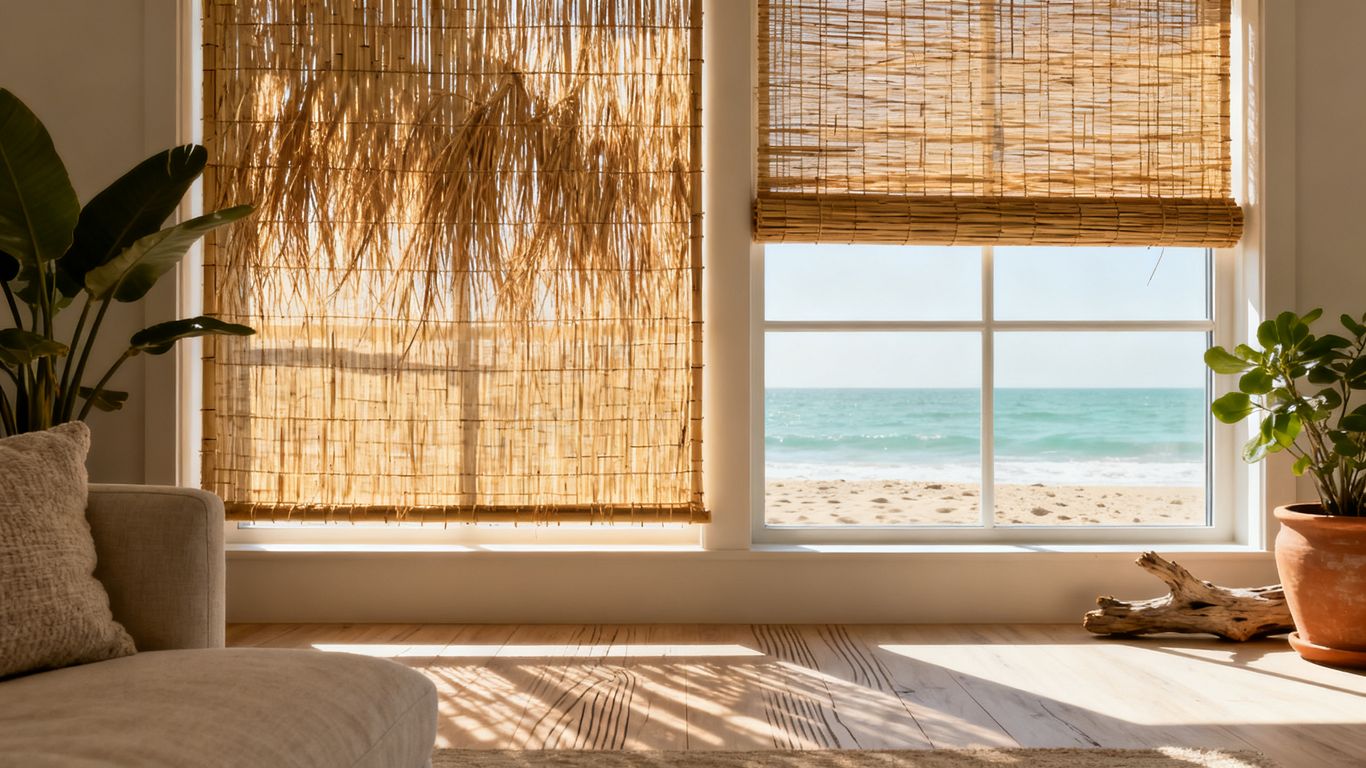
Bamboo often reads clean and lightly structured, while jute tends to look more tactile and relaxed. Grasses and reeds can bring a coastal or rustic note, especially when their natural variation remains visible. Materials can also be mixed within a home so each room feels related without looking identical.
For a warm neutral interior, consider honey, straw, sand, or tobacco tones. Cooler gray-brown fibers can sit comfortably with painted cabinetry, stone, and modern upholstery. Samples are worth viewing in the actual room because daylight can change the apparent color considerably.
Selecting colors, patterns, and edge bindings
Color is only one part of the decision. A fine, even weave creates a quieter backdrop, while irregular fibers make the shade more noticeable. Edge bindings can frame the panel and give it a finished appearance, particularly on wide windows or doors.
Use contrast carefully. A darker binding can echo nearby furniture or hardware, but a close match often creates a calmer result. If you plan to layer the shade with drapery, keep the woven panel simple enough that both treatments can breathe.
Using woven shades in modern, coastal, farmhouse, and bohemian interiors
Natural woven shades fit more styles than their rustic reputation suggests. In a modern room, a simple weave adds warmth to straight lines. In a coastal space, pale fibers reinforce the relaxed palette. Farmhouse rooms can handle more visible texture, while bohemian interiors can support richer tones and layered textiles.
Made in the Shade North Jersey offers woven wood shades crafted from bamboo and other natural fibers, making them a practical option when the goal is organic texture with a custom window treatment. The important part is choosing a material that supports the room instead of turning every window into a focal point.
Coordinating shades across open-concept rooms
Open-concept spaces need consistency, but they do not require every shade to be identical. Keep the main material family and color range consistent, then adjust lining or operating style according to each window’s job.
For example, a living room may use a light-filtering liner while an adjoining dining area uses a denser option. Repeating the same edge detail or headrail finish helps the rooms feel connected. This approach is especially useful when windows face different directions.
Balancing light control and privacy
Woven shades are naturally good at softening harsh daylight, but privacy depends on the weave, the window’s exposure, and the time of day. A shade that feels private in daylight may look translucent at night when the room is lit. Treat light control and privacy as separate decisions rather than assuming one solves both.
Choosing open weaves for filtered natural light
Open weaves work well where you want daylight without the sharp contrast of bare glass. They diffuse the sun and preserve some connection to the outdoors, which makes them appealing in living rooms, sunrooms, and bright kitchens.
They are less suitable when you need a reliable visual barrier. If a window faces a neighboring home or a busy sidewalk, an open weave may need to be paired with a liner or another treatment.
When to select a tighter weave for added privacy
A tighter weave reduces the amount of light and visibility passing through the shade. It is often a better starting point for bedrooms, bathrooms, and street-facing windows. Still, fiber density alone does not guarantee complete privacy, so check a sample from both sides of the glass if possible.
The window’s height matters too. A lower window may need stronger coverage than a high clerestory window, even if both receive similar sunlight. Good planning considers sightlines, not just fabric.
Comparing light-filtering and blackout liners
A light-filtering liner softens daylight and improves privacy without making the room completely dark. A blackout liner blocks far more light and is useful in bedrooms, nurseries, media rooms, or any space where daytime darkness matters.
Here is a simple way to compare the common choices:
| Shade setup | Daylight | Privacy | Best fit |
|---|---|---|---|
| Open weave, no liner | High and softly diffused | Limited at night | Sunrooms and bright living areas |
| Tighter weave, no liner | Moderate | Better, but variable | Dining rooms and offices |
| Light-filtering liner | Soft and controlled | Stronger | Living spaces and street-facing windows |
| Blackout liner | Very low | Highest | Bedrooms and media rooms |
The liner changes the character of the shade as much as the weave does. Decide whether you want a gentle daytime glow or dependable darkness before finalizing the fabric.
Using top-down, bottom-up designs for flexible coverage
Top-down, bottom-up operation lets you lower the shade from above or raise it from below. That can preserve daylight at the top of a window while covering the lower portion where privacy matters most.
This configuration is useful in bathrooms, bedrooms, and homes with close neighbors. It also reduces the need to choose between a fully open window and a fully covered one. Ask about the available operating system early, since it can affect the final construction and price.
Improving comfort and energy efficiency
Natural woven shades can contribute to a more comfortable room, particularly when they cover glass that receives strong sun or feels cold in winter. Their benefits are modest but meaningful: the woven structure creates small air pockets, and a liner adds another layer between the glass and the room. Use them as part of a larger comfort plan, not as a replacement for insulation or efficient windows.
How woven materials provide natural insulation
The fibers and small spaces within a woven panel slow some movement of heat between the window and the room. In summer, the shade can reduce the intensity of direct sun. In winter, it adds a little separation from cold glass.
The effect depends on the window, the fit, the orientation, and how consistently the shade is closed. A well-fitted shade generally performs better than one with large side gaps, but expectations should remain realistic.
Adding thermal liners for better temperature control
A thermal liner increases the barrier behind the woven material. It can help reduce heat gain in sunny rooms and heat loss near cold windows, while also improving privacy and light control. The trade-off is that the liner may hide some of the natural texture from the room or outside view.
Made in the Shade North Jersey describes woven wood options alongside professional measuring and installation services. That combination is useful when a liner, unusual window, or tight fit makes the decision more complicated than selecting a color online.
Reducing glare and protecting furniture from UV exposure
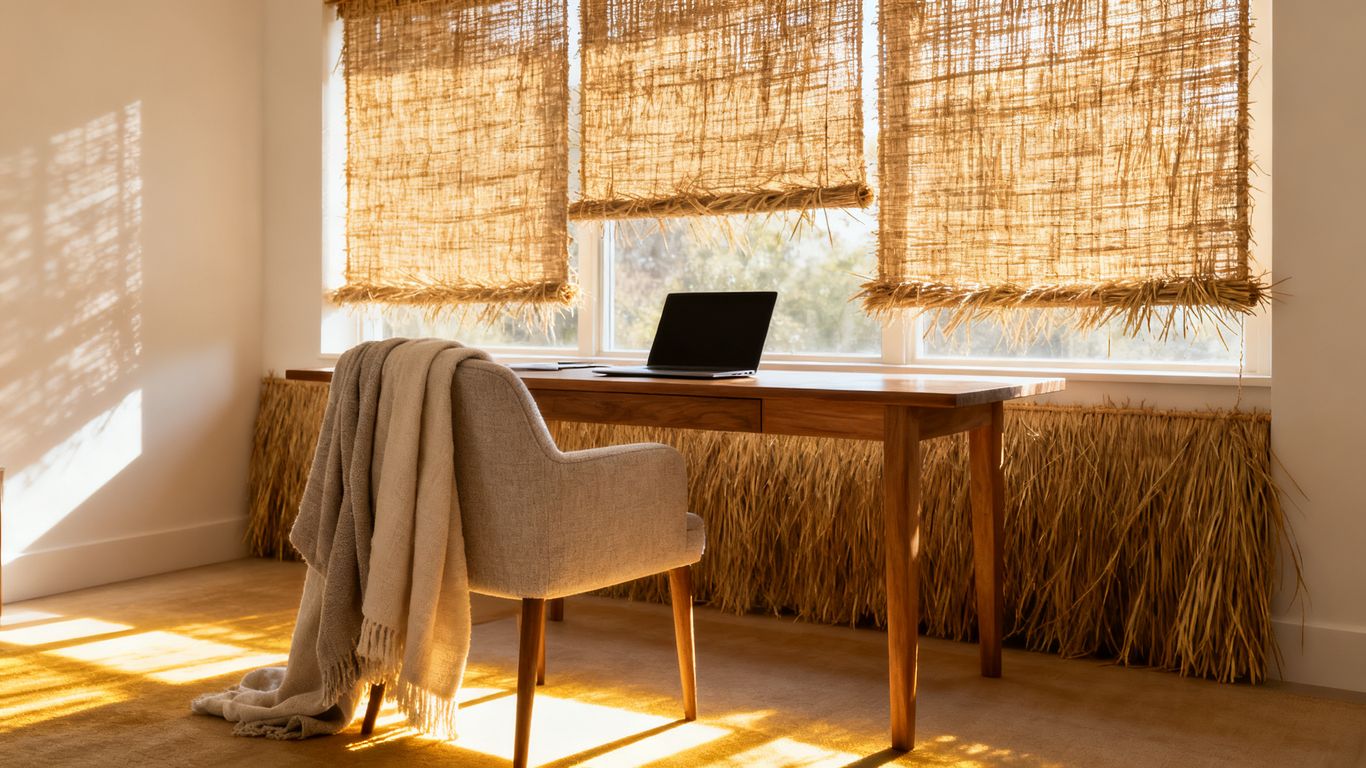
Filtered light is easier on screens and helps reduce the sharp glare that makes a home office or television area uncomfortable. Window coverings can also limit direct sunlight reaching floors, upholstery, artwork, and wood finishes. They cannot stop every ultraviolet ray, but they can reduce the intensity of exposure.
For a room with a valuable view, consider whether you need privacy, glare reduction, or heat control most. A solar-oriented treatment may be better for preserving a view, while a lined woven shade may be the better design choice when texture is central to the room.
Understanding the limits of energy savings
Woven shades can support comfort, but they will not transform a poorly insulated home by themselves. Air leaks, old windows, roof insulation, and HVAC performance usually have a larger effect on energy use. The shade is one layer in the envelope of the room.
Use the treatment strategically. Close it during the hottest part of a sunny day, then open it when winter sunlight can warm the interior. Small routines often matter more than optimistic claims about a single product.
Selecting safe and convenient operating features
Operating style affects how often you use a shade and how well it fits the room. A cordless lift keeps the window area visually clean, while motorization helps with height, reach, and routine control. Choose the simplest system that solves the actual problem.
Benefits of cordless lift systems
Cordless shades remove dangling lift cords and create a neater appearance. They are especially useful around children and pets, and they make sense on frequently used windows where a simple hand adjustment is all you need.
Made in the Shade North Jersey provides cordless lift options for natural woven shades. That documented option is worth considering when safety and a clean finish matter more than remote control.
When motorized woven shades make sense
Motorization earns its place on tall windows, wide groupings, skylights, and openings that are difficult to reach. It can also help when several shades need to move together. For a small, easy-to-reach window, manual operation may be more practical and less costly.
Made in the Shade North Jersey also provides motorized operation options for hard-to-reach windows. The best decision is usually based on access and routine, not on technology for its own sake.
Rechargeable batteries and solar-powered options
Battery-powered systems can avoid visible wiring and simplify installation where electrical access is limited. Rechargeable batteries reduce the need for frequent replacement, but they still require occasional attention. Solar-powered options may be useful on bright, exposed windows, depending on the specific system and room conditions.
Ask how the power source is charged, where components are placed, and what happens if the battery is low. Those details are more useful than choosing a feature simply because it sounds advanced.
Integrating shades with smart-home controls
Smart-home control can connect shade operation with routines, time of day, or other household commands when the selected system supports it. Made in the Shade North Jersey documents smart-home automation integration for custom shades, which can be helpful when convenience and coordinated daily movement are priorities.
Before choosing this route, confirm compatibility with the system already in your home. Also decide which windows truly need automation. A few well-chosen motorized shades may deliver more value than automating every opening.
Planning for installation and long-term care
Natural fibers reward careful planning. Measuring, mounting, cleaning, and protecting the shade from moisture all affect how it looks over time. A consultation can also reveal practical issues that are easy to miss from a photograph, such as trim interference, uneven window depth, or a door handle in the shade’s path.
Measuring standard and uniquely shaped windows
Measure width and height at several points because window openings are not always perfectly square. Record the inside depth, nearby trim, sill projection, and how the window opens. For large or unusually shaped windows, the mounting location can be as important as the finished dimensions.
Do not assume two windows that look alike will measure alike. Small differences become visible when shades sit next to each other, especially across a wide wall.
Solutions for French doors, skylights, and hard-to-reach windows
French doors need a treatment that clears handles and moves with the door. Skylights may require specialized mounting and an operating system that can be reached or automated. Tall windows create similar access concerns, even when their shape is standard.
Made in the Shade North Jersey offers professional measuring and installation services, which can reduce guesswork for these applications. A good plan accounts for operation, clearance, and the way the treatment will look when the door or window is in use.
Cleaning and maintaining natural woven materials
Dust woven shades gently with a soft brush attachment or clean, dry cloth. Avoid saturating the fibers, since moisture can affect natural materials and encourage distortion. Keep sprays and harsh cleaners away from the shade unless the manufacturer specifically approves them.
A simple maintenance routine usually works best:
- Dust lightly before buildup becomes visible.
- Test any cleaning method on an inconspicuous area first.
- Keep woven materials away from persistent moisture.
- Raise or lower the shade evenly to reduce strain.
Regular, gentle care helps preserve the texture without turning maintenance into a project. If a shade becomes stained or warped, ask for product-specific guidance before trying a stronger cleaner.
Why professional consultation and installation matter
Professional help is not only about getting the measurements right. It gives you a chance to compare samples in your own light, discuss privacy at night, and select a liner or control that fits the way the room is used. Installation also affects alignment, clearance, and the finished appearance.
For homeowners who want to compare materials and operating choices in person, a woven shade consultation can make the process less overwhelming. The goal is a treatment that looks considered on day one and remains easy to live with afterward.
Conclusion
Woven wood shades are a strong choice when you want natural texture, softened daylight, and a warmer finish at the window. The best result comes from matching the weave, liner, color, and operating system to each room rather than treating every window the same. With careful measuring and realistic expectations about insulation, these shades can bring together comfort, privacy, and design in a way that feels personal.
Frequently Asked Questions
Are woven wood shades made from real natural materials?
Yes. Common materials include bamboo, jute, grasses, reeds, and other plant-based fibers. The exact blend varies, so check the product specifications when material content matters to you.
Can you see through woven wood shades?
It depends on the weave and lighting conditions. Open weaves may allow views or silhouettes, especially at night, while tighter weaves and liners provide more privacy.
Do woven wood shades block all sunlight?
Unlined woven shades usually filter or soften sunlight rather than block it completely. A blackout liner is the better choice when you need substantial darkness.
Are woven wood shades energy efficient?
They can provide a modest insulating layer by creating small air spaces between fibers. A thermal liner can improve temperature control, but the shades are not a substitute for proper window and building insulation.
Are cordless woven shades safer for children and pets?
Cordless designs remove dangling lift cords and can create a cleaner, safer window area. Follow the care and operating instructions for the specific product.
How should woven wood shades be cleaned?
Dust them gently with a soft brush attachment or dry cloth. Avoid excess moisture and harsh cleaners unless the manufacturer gives different instructions.
Do woven wood shades work on doors and unusual windows?
They can be adapted to some doors, skylights, tall windows, and specialty shapes, but the mounting and operating requirements vary. Careful measuring is especially important for these applications.
See Your Options In Person
If you are comparing woven wood shades for a North Jersey home, Made in the Shade North Jersey can bring window treatment options to you for a more informed decision. Request a consultation to review materials, light control, privacy, and installation needs in the rooms where the shades will live.